Guitar Lessons Riyadh
Whether you have never held a guitar or you are working through your first barre chords, finding the right starting point matters more than most people realize. A practical entry into music education means knowing what to look for, what questions to ask, and how different lesson formats actually fit into a busy schedule.
Comparing local options can feel overwhelming when every provider lists similar promises but few explain the details that affect your progress — session length, lesson frequency, genre focus, or how quickly a complete beginner moves into real songs. Without a clear picture of scope and structure, it is easy to sign up for something that does not match where you are right now.
This page lays out the key factors to weigh when choosing guitar instruction: teaching methodology, available session formats including 30-minute sessions and 45-minute sessions, flexible arrangements from single lessons to class packages covering 4, 8, 16, 24, and 40 lessons, and how online music lessons expand your access beyond geography. You will also find guidance on selecting your first instrument and building practice habits that compound over time.
Start Your Guitar Journey in Riyadh Today! Use the information here to evaluate your options clearly and take the next step with confidence.
A practical starting point for guitar lessons riyadh.
It is hard to compare scope, fit, and next steps without a clear guide.
This page outlines how to evaluate options and move forward with confidence.


Why Learn Guitar in Riyadh?
Riyadh's music scene has grown steadily over recent years, with live venues, community jam sessions, and a rising appetite for music education drawing students of all ages toward instruments they once only admired from a distance. Choosing guitar lessons riyadh gives you access to a local learning environment where you can connect with like-minded musicians, find practice partners, and build skills that translate directly to real performances in the city.
Learning guitar carries well-documented personal benefits beyond the stage. Regular practice sharpens fine motor coordination, strengthens memory through chord and scale recall, and provides a reliable creative outlet for managing daily stress. For younger students, structured music education builds discipline and concentration that carries over into academic performance. For adults returning to an instrument after years away, lessons offer a structured re-entry that avoids the frustration of self-teaching from scattered online videos.
Riyadh's growing network of music communities means that progressing guitarists quickly find opportunities to apply what they learn — whether that is joining a small ensemble, contributing to a recording project, or simply playing confidently for friends and family. Pairing in-person study with online music lessons when schedules are tight ensures that momentum never stalls between sessions. Flexible formats including 45-minute sessions make it realistic to fit consistent practice into even a packed Riyadh workweek, so progress stays on track from the very first lesson.
Guitar Lessons for Every Skill Level
Quality music education should meet you exactly where you are — whether you have never held a guitar or you are already playing confidently and want to push further. Lessons at JEVON Music and Arts are structured to serve three distinct stages of development, so no student is placed in a program that moves too fast or too slow for their current ability.
Beginner Guitarists
If you are picking up the instrument for the first time, early lessons focus on building a reliable foundation: correct posture, fretting-hand position, basic open chords, and simple strumming patterns. You will also learn to read chord diagrams and basic tablature so you can start practising independently between sessions. Genres introduced at this stage include pop, folk, and light rock — styles that use accessible chord shapes and keep motivation high.
Intermediate Guitarists
Students who already know their open chords and a handful of songs move into more demanding territory: barre chords, pentatonic scales, fingerpicking patterns, and an introduction to music theory concepts such as keys and intervals. Genre options broaden to include blues, classical, and acoustic fingerstyle, allowing you to develop a personal direction rather than following a single fixed syllabus.
Advanced Guitarists
Advanced lessons address technique refinement, extended harmony, improvisation over chord progressions, and genre-specific stylistic nuance. Whether your goal is jazz comping, classical repertoire, or lead rock playing, the curriculum adapts to your target style. Students at this level are also encouraged to explore composition and arrangement, turning technical ability into genuine creative output.
Across all levels, the programme at JEVON Music and Arts is designed to nurture talent from beginner to advanced, giving every student a clear path forward regardless of where they start.
Our Guitar Teaching Methodology
A strong teaching methodology is what separates steady progress from frustrating plateaus. At JEVON Music and Arts, the approach to guitar instruction is built on three interconnected pillars: physical technique, music theory, and practical application — each reinforcing the other throughout every stage of learning.
Building Technique from the Ground Up
Lessons begin with posture, hand positioning, and fretting accuracy before moving into more complex movements. Developing clean technique early prevents the bad habits that slow down intermediate players later. Students work through targeted finger exercises, chord transitions, and picking drills that are matched to their current ability rather than a fixed syllabus.
Music Theory That Actually Makes Sense
Theory is introduced in direct connection with what a student is already playing. Understanding scales, chord construction, and rhythm patterns becomes far easier when you can immediately hear and apply the concept on the guitar in front of you. This practical framing makes music education genuinely useful rather than abstract.
Genre-Specific Application
Whether a student is drawn to classical fingerpicking, rock rhythm playing, or acoustic pop, the methodology adapts to the genre. Technique and theory are filtered through the musical context that motivates each learner, which keeps practice purposeful and engagement high.
In-Person and Online Music Lessons
The same structured methodology applies whether you attend in person or join via online music lessons. Remote sessions use screen sharing and real-time audio feedback so instructors can observe hand position, correct timing issues, and guide theory exercises just as effectively as face-to-face instruction. Students receive written notes after each session so they know exactly what to focus on before the next class.
Every element of the curriculum — from warm-up routines to song selection — is chosen to move each individual student forward in a measurable, motivated way.
What to Expect in Your Lessons
Walking into your first session — or your fiftieth — should never feel like a guessing game. A well-structured guitar lesson in Riyadh follows a consistent rhythm that balances technical work, musical theory, and hands-on playing so that every minute counts.
A typical session opens with a short warm-up: finger stretches, scale runs, or chord transitions that prime your hands and focus your mind. From there, your instructor reviews what you practiced since the last meeting, identifying both progress and specific sticking points. This honest check-in shapes the rest of the lesson rather than following a rigid script, which means feedback is always personalized to where you actually are.
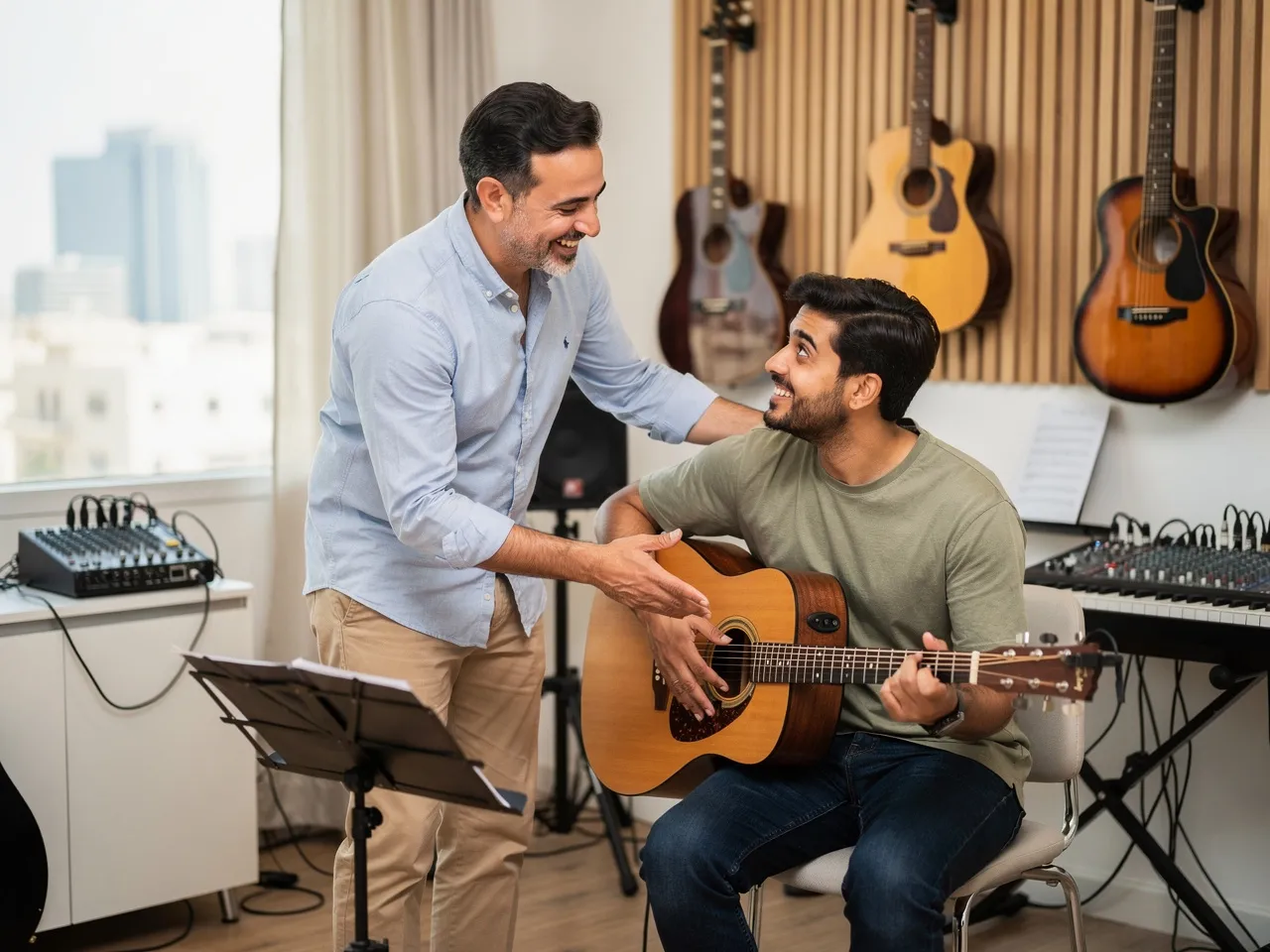
The core of each lesson introduces or deepens one key concept — a new chord shape, a strumming pattern, a section of a song you are working toward. Your instructor demonstrates, you attempt it, and targeted corrections follow immediately. This loop of demonstration, practice, and feedback accelerates learning far more effectively than solo practice alone.
Sessions close with a clearly defined home-practice assignment. You will leave knowing exactly which exercises to repeat, how many minutes to spend on each, and what to listen for in your own playing. This structure keeps progress measurable between lessons.
Music education here extends beyond the guitar itself. Students who are also exploring vocal training & singing lessons will find that guitar work and voice work reinforce each other — understanding rhythm and melody on the fretboard directly sharpens your ear for pitch and timing when you sing.
- Warm-up: Targeted finger and technique exercises to prepare for focused work
- Review: Honest assessment of home practice with specific, constructive feedback
- New material: One clearly explained concept introduced and practiced in real time
- Assignment: A precise practice plan to carry you confidently to the next session
Choosing the Right Guitar for You
Picking your first guitar is one of the most important decisions you will make as a new player. The right instrument makes practice enjoyable and progress faster, while the wrong one can create unnecessary frustration. Here is a practical guide to help you choose wisely before you begin your music education journey.
Acoustic vs. Classical vs. Electric
- Classical (nylon-string) acoustic: Easier on fingertips and ideal for fingerpicking styles, flamenco, and classical repertoire. The wider neck can feel challenging for small hands at first.
- Steel-string acoustic: Versatile for folk, pop, and singer-songwriter styles. No amplifier needed, making it convenient for home practice in Riyadh.
- Electric guitar: Lower string action means less finger pressure, which many beginners find comfortable. You will need a small practice amplifier, but volume can be kept low for apartment living.
Body Size Matters
Younger students or players with a smaller frame often find a three-quarter-size or parlour-body guitar more comfortable. Full-size dreadnoughts produce a fuller sound but can be awkward to hold for extended practice sessions.
Budget Guidance
A reliable beginner instrument typically falls in the mid-range price bracket — enough to hold tuning and stay playable, but not so expensive that a change of direction feels costly. Avoid the very sensible options available online, as poor intonation and high action make learning significantly harder.
Try Before You Buy
If possible, visit a local music shop in Riyadh and hold several guitars before purchasing. Pay attention to how the neck feels in your fretting hand and whether the body sits comfortably against your torso.
Single Lessons Can Help You Decide
If you are still unsure which style suits you, booking single lessons early in your search is a smart move. A qualified instructor can assess your hand size, musical taste, and goals, then recommend the most suitable guitar type before you invest in an instrument. This one-session consultation approach saves money and removes guesswork from the process.
Once you have your guitar, keep it in a stable environment — Riyadh's dry climate can cause wooden instruments to crack if humidity levels drop too low. A basic humidifier inside the case protects your investment year-round.
Practice Tips for Guitarists
Consistent, focused practice separates students who plateau from those who make steady, visible progress. Whether you are working through your first chords or refining advanced fingerpicking patterns, how you practice matters as much as how often you practice. The following habits will help you get the most from every session between your guitar lessons in Riyadh.
- Practice in short, focused blocks. Twenty minutes of deliberate, distraction-free practice outperforms an hour of unfocused noodling. Set a timer, silence your phone, and commit fully to one skill at a time.
- Isolate the difficult passage. When a chord transition or riff feels awkward, slow it down to a tempo where you can play it cleanly, then gradually increase speed. Rushing through mistakes only reinforces them.
- Use a metronome from day one. Rhythm is the foundation of music education. A free metronome app is all you need to build timing that will serve you across every genre you explore.
- Record yourself regularly. Listening back reveals timing gaps, muted strings, and tone issues that are easy to miss while playing. Even a phone recording is enough to give you honest, objective feedback.
- Review what your instructor assigned. Your teacher designs exercises to address your specific weak points. Prioritise those tasks before exploring new material on your own.
- Plan your practice around your lesson schedule. If you are enrolled in class packages (4, 8, 16, 24, 40 lessons), map out practice goals for each block so that every lesson builds logically on the last. Students who arrive prepared consistently progress faster than those who rely solely on lesson time.
- Complement your guitar work with broader musical study. Listening critically to recordings, exploring basic music theory, and even attending vocal training & singing lessons can sharpen your ear and deepen your understanding of how melody and harmony interact.
Progress on the guitar is cumulative. Small, consistent efforts compound over weeks and months into real skill. Treat each practice session as an investment in the musician you are becoming.
Flexible Lesson Packages
Structuring your guitar education around a consistent schedule is one of the most reliable ways to build real skill. That is why a range of booking options exists to suit different budgets, goals, and weekly availability — whether you are just testing the waters or committing to a long-term music education plan.
Single Lessons
Single lessons are ideal if you want to try a session before committing, work on one specific technique, or simply keep your schedule open. There is no obligation to book ahead in bulk, making this the most flexible entry point for anyone exploring guitar tuition in Riyadh.
Class Packages
For students who are ready to progress steadily, class packages offer better value and built-in accountability. Available package sizes include:
- 4-lesson package — a short block to establish fundamentals or revisit a specific skill area
- 8-lesson package — enough time to move through a structured beginner or intermediate module
- 16-lesson package — a solid mid-term commitment that allows for meaningful technique development and repertoire building
- 24-lesson package — suited to students working toward a performance goal or advancing through multiple genres
- 40-lesson package — the most comprehensive option, supporting long-term music education with consistent weekly progress
Session Lengths
Lessons are available in three durations so you can match the format to your age, attention span, and learning objectives:
- 30-minute sessions — well-suited to younger beginners or anyone focusing on a single concept per week, keeping each session focused and manageable
- 45-minute sessions — a balanced choice for intermediate students who need time for warm-up, technique work, and a short piece or exercise
- 60-minute sessions — recommended for advanced players or those combining vocal training & singing lessons alongside guitar, allowing deeper exploration in each sitting
Online music lessons are also available across all package sizes and session lengths, giving Riyadh-based students the option to learn from home without interrupting their progress. Whichever combination you choose, the goal remains the same: consistent, personalised instruction that moves you forward at a pace that works for your life.
Ready when you are
Start Your Guitar Journey in Riyadh Today!